

When someone in your city types “lawyer near me,” will you show up?
Modern clients don’t start their search in the Yellow Pages — they reach for their phones. For law firms in the U.S., mastering digital marketing for law firms means dominating local search so you’re the first name people see when legal help is needed right now. In this guide, I’ll take you behind the scenes with strategies that aren’t just theory — real tactics I’ve seen work and evolve in competitive markets.
Why Local Search Matters (More Than You Think)
The “Near Me” Explosion
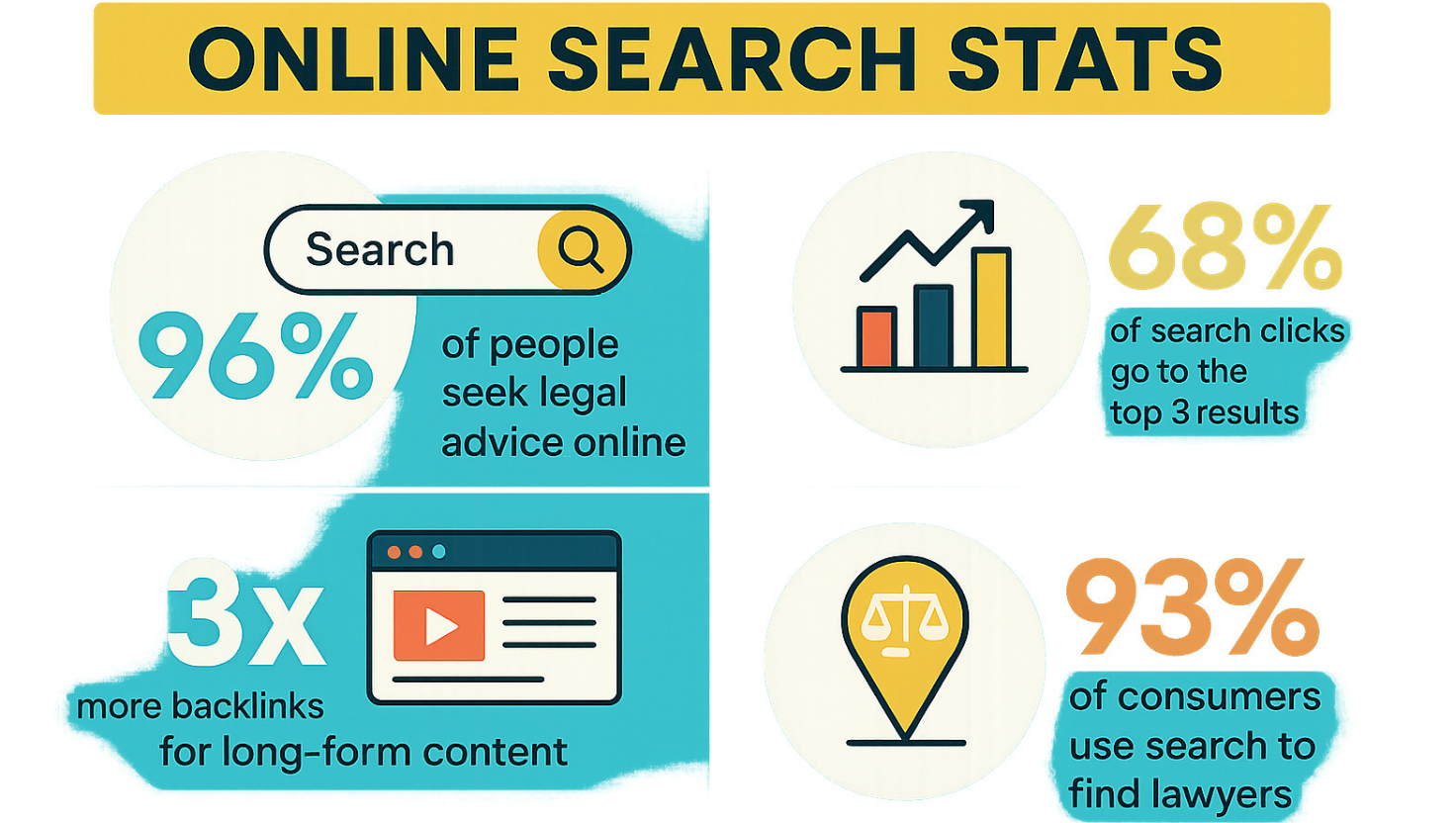
- 76% of people who search locally on mobile visit a business within 24 hours. (Law Leaders)
- Many searches for legal help happen in urgent moments — someone just got hurt, just got a DUI, or needs emergency family law assistance. You don’t have time to lose.
- Local + organic results together account for ~69% of digital traffic in many markets. (On The Map Marketing)
The 3 Pillars of Google’s Local Ranking
To take a top spot in the Local Pack (the map + top 3 listings), Google considers three core signals: relevance, distance, and prominence. (GAVL)
- Relevance — Does your profile clearly signal you do what the searcher wants (e.g., “car accident lawyer in [City]”)?
- Distance — How physically close you are to the searcher (or the area Google estimates).
- Prominence — How well-known or authoritative your firm is locally. This includes reviews, backlinks, citations, mentions, content, and more.
If you optimize only your website, but ignore local signals (Google Business Profile, directories, reviews), you’re leaving a huge opportunity on the table.

Foundations Before You Build
Before pushing hard on advanced tactics, make sure your base is rock solid.
1. Google Business Profile (GBP) Optimization
- Claim and verify all your listings.
- Use all fields — services, business description, categories, attributes. (Digital Law Marketing)
- Add high-quality photos (office, team, exterior) and videos.
- Regularly post updates, service changes, offers, and legal tips.
- Use the Q&A section, respond to reviews, and actively manage it.
2. NAP (Name, Address, Phone) Consistency
Everywhere your firm appears — your website, directory listings, partner sites — your firm name, address, and phone number must be exactly the same (no abbreviations, no variations). Discrepancies hurt trust with Google and confuse clients. (GAVL)
3. Clean Up Duplicate or Spam Listings
Many firms find they have multiple Google or directory listings for the same address — sometimes created by old marketing firms or directories. Audit them and remove duplicates. (Digital Law Marketing)
4. Local Keyword Research & On-Page Signals
- Identify local keywords (e.g., “Chicago personal injury attorney,” “DUI lawyer in Austin”) using tools like SEMrush, Ahrefs, or Google’s Keyword Planner. (GAVL)
- Embed those local keywords into title tags, meta descriptions, headers, and content.
- Use schema markup (LocalBusiness, Attorney) to give search engines structured data — especially address, service area, and hours.
Advanced Tactics to Dominate Local Search
1. Location Pages & Hyperlocal Content
If your firm serves multiple counties, cities, or neighborhoods, create dedicated location pages or microsites — each optimized for the specific area with content that addresses that community’s needs.
But avoid content duplication — each should be unique, with custom intros, case studies, and local signals.
2. Content That Ranks Locally
Produce blog posts or guides tied to local events, city/regional laws, and common legal issues in your area (e.g. “How Colorado’s new DUI law affects Denver drivers”).
These serve two goals:
- Capture local search queries
- Build authority with local readers who may share or link to it
3. Reviews & Reputation Strategies
Reviews are a major part of the “prominence” signal. (Digital Law Marketing)
- Ask satisfied clients to review your firm on Google, Avvo, Yelp, or relevant legal directories
- Automate requests (via email or SMS) with a friendly follow-up
- Always respond — both to praise and to criticism
- Use review snippets or testimonials in your local pages
4. Local Citations & Directory Listings
- Build consistent citations in local legal directories, state bar associations, city biz directories, and industry-specific legal platforms
- Ensure your directory entries are updated and active
- Prioritize high-authority directories and local chambers or organizations
5. Link Building with Local & Legal Relevance
- Sponsor or partner with local nonprofits, events, or legal associations — get mentioned on their websites
- Guest publish on local blogs or news sites about legal issues
- Publish data, whitepapers, or research specific to your area, and reach out for press coverage
6. Mobile Optimization & Speed
Many local searches happen on mobile. If your site doesn’t load fast or is clunky to navigate, you’ll lose visitors — and Google will penalize you.
- Use Google’s PageSpeed Insights to spot issues
- Optimize images, minimize plugins, use clean design and caching
- Implement AMP (Accelerated Mobile Pages) for blog posts, if feasible
7. Call Tracking, Analytics & Attribution
Track which calls or leads came from local search vs other sources. Use call tracking numbers or UTM parameters to segment and analyze performance.
Adjust strategies based on what neighborhoods or keywords drive results.
Real-World Wins & Pitfalls
What Worked in a Crowded Market
I once consulted for a midsize personal injury firm in a dense metro area. Their competition was well-established, but their GBP was half-baked — no photos, poor description, few reviews. After:
- Fully optimizing their GBP
- Launching neighborhood-level pages
- Running a review-request campaign
- Earning local backlinks (e.g. sponsoring local sports events)
They moved from page two to the Local Pack in less than six months, and their inbound calls increased ~45%.
What Fails Too Often
- Building dozens of location pages with no unique content — Google flags them as thin or duplicate
- Ignoring negative reviews or letting them sit
- Relying too heavily on PPC and ignoring the “organic + local” combo
- Forgetting to maintain NAP consistency after rebranding or relocation
Content & Metric Snapshot
Here’s a quick comparison table to help you prioritize:
| Metric / Strategy | Importance | Quick Win Tip |
|---|---|---|
| Google Business Profile | Very High | Fully fill fields & post twice weekly |
| Reviews & Reputation | High | Send review requests post-case closure |
| Local Keywords | High | Use variants like “[City] + practice area” |
| Location Pages | Medium–High | One page per city/neighborhood, unique copy |
| Local Backlinks & Citations | Medium | Partner with local orgs, write press releases |
| Mobile Speed / UX | Very High | Test mobile load times & fix slow assets |
Wrapping Up & What to Do Next
Digital marketing for law firms in the U.S. is no longer optional — it’s essential. But to dominate local search, you need more than a website: you need a living local ecosystem — GBP, reviews, backlinks, neighborhood content, and analytics all working in harmony.
Next steps:
- Audit your current GBP, citations, and NAP consistency
- Build or upgrade your location pages with local content
- Kickstart a review request & management campaign
- Develop local backlink outreach strategies
- Monitor performance and continuously optimize
If you’d like help crafting a content calendar or tracking framework tailored to your state or city, I’d love to assist — just ask.
