


Introduction: Why Most Amazon PPC Campaigns Fail Before They Begin
If you’ve ever run an Amazon PPC campaign and felt disappointed by the results, you’re not alone. Many new sellers dive into Amazon ads hoping to skyrocket sales, only to end up with high costs, low clicks, and zero conversions.
Here’s the truth: Amazon PPC (Pay-Per-Click) is one of the most powerful tools in digital marketing, but it’s also one of the easiest to misuse. One wrong keyword, one unchecked setting, or one lazy ad structure can drain your ad budget faster than you can say “Sponsored Product.”
In this EduKester-style guide, we’ll uncover the most common Amazon PPC mistakes beginners make, explain why they’re so damaging, and show you exactly how to fix them — so you can start running profitable campaigns that actually convert.
1. Mistake #1: Not Defining a Clear PPC Goal
Most beginners start Amazon PPC without a plan — they just “run ads” and hope for the best. But Amazon’s algorithm rewards clarity and data, not luck.
Before you spend a dollar, ask yourself:
- Am I trying to launch a new product?
- Do I want to boost organic ranking?
- Am I aiming for profit or visibility?
Each goal requires a different approach.
✅ How to Fix:
- For product launches, focus on Sponsored Products with high bids to gain traction.
- For profit-focused ads, analyze ACoS (Advertising Cost of Sales) and lower bids gradually.
- For visibility, use Sponsored Brand campaigns with branded keywords.
Remember, “a goal without a plan is just an expensive wish.”
2. Mistake #2: Ignoring Keyword Match Types
One of the biggest beginner blunders in Amazon PPC is not understanding match types — Broad, Phrase, and Exact.
Here’s how they differ:
| Match Type | Example Keyword | Triggered Searches | Use Case |
|---|---|---|---|
| Broad | “wireless headphones” | bluetooth headphones, over-ear wireless | Discovering new keywords |
| Phrase | “wireless headphones” | best wireless headphones for gym | Controlling variations |
| Exact | “wireless headphones” | only exact phrase | Targeting proven keywords |
New advertisers often use only Broad Match, wasting ad spend on irrelevant clicks.
✅ How To Fix:
- Start broad for discovery → move to phrase → then exact match for top converters.
- Analyze your Search Term Report weekly to identify profitable keywords.
Pro Tip: Use negative keywords to block irrelevant searches that drain your budget.
3. Mistake #3: Poor Campaign Structure
Throwing all products into one campaign is a PPC disaster waiting to happen. Amazon’s algorithm can’t optimize properly when your data is mixed.
✅ How To Fix:
- Separate campaigns by product type or category.
- Create individual ad groups for variations (colors, sizes, etc.).
- Don’t mix unrelated products — it confuses both Amazon and your budget allocation.
This allows you to see which products perform best, pause losers, and scale winners efficiently.
4. Mistake #4: Not Tracking or Understanding ACoS and TACoS
Many sellers look at sales alone and ignore ACoS (Advertising Cost of Sale). Big mistake.
High ACoS means you’re spending too much per sale, but TACoS tells the bigger story — how ads impact your overall business.
✅ How To Fix:
- Monitor both ACoS and TACoS.
- If TACoS decreases over time, your organic ranking is improving (great!).
- If TACoS increases, your ads aren’t converting efficiently.
My Insight: Aim for a balance — some products can tolerate higher ACoS during launch, but scale only when profitability improves.
5. Mistake #5: Forgetting About Negative Keywords
Imagine paying for clicks from people who were never going to buy your product — that’s what happens when you don’t use negative keywords.
Example:
If you sell “luxury leather wallets,” and your ad appears for “cheap wallets,” you’re wasting money.
✅ Best Way To Fix:
- Review your Search Term Reports weekly.
- Add irrelevant or low-converting terms as negative keywords.
- Use campaign-level negatives to avoid duplication.
Pro Tip: Even one week of unchecked negative keywords can destroy your profitability.
6. Mistake #6: Ignoring Product Listing Optimization
Here’s a harsh truth — even the best Amazon PPC campaign can’t fix a bad product listing.
If your title, images, or reviews are weak, you’ll get clicks but no conversions — and Amazon’s A9 algorithm will quickly lower your ranking.
✅ Key To Fix:
Before running ads, optimize your listing for:
- Keyword-rich titles that are clear and readable.
- High-quality images (at least 1000×1000 pixels).
- Persuasive bullet points that sell benefits, not just features.
- A+ Content to boost credibility and conversion.
Remember: PPC drives traffic. Listing optimization drives sales.
7. Mistake #7: Setting and Forgetting Campaigns
Amazon PPC isn’t a “set it and forget it” game. It requires constant optimization.
Many beginners leave their campaigns untouched for weeks, unaware that:
- CPCs fluctuate daily.
- Competitors change bids and keywords.
- Amazon’s algorithm continuously evolves.
✅ How to Fix:
- Check performance every 2–3 days during the first two weeks.
- Adjust bids based on CTR, CPC, and conversions.
- Pause underperforming keywords; increase bids on high performers.
EduKester Reminder: Optimization isn’t optional — it’s your ticket to profitability.
8. Mistake #8: Relying Only on Automatic Campaigns
Automatic campaigns are great for discovery, but relying on them 100% is a rookie mistake. Amazon decides which keywords to target — and it doesn’t always choose wisely.
✅ Let Fix:
- Use automatic campaigns to find converting keywords.
- Transfer those winning keywords to manual campaigns for tighter control.
- Turn off underperforming automatic campaigns to save costs.
Example:
If your automatic campaign finds “vegan protein powder” converts well, move it to a manual exact-match campaign and raise the bid to dominate that niche.
9. Mistake #9: Ignoring the Power of Product Targeting Ads
Many sellers focus solely on keyword targeting and forget product targeting ads — one of the most effective tools in Amazon PPC.
These ads allow you to appear directly on competitor product pages, giving you an edge to steal their traffic.
✅ Ways to Fix:
- Target competitor listings with lower ratings or higher prices.
- Cross-promote your own complementary products (e.g., phone + case).
- Use ASIN targeting strategically to boost visibility and conversions.
10. Mistake #10: Not Leveraging Brand Analytics and Reports
Amazon gives you data gold — but many beginners never use it.
Brand Analytics provides insights like:
- Top converting keywords.
- Market basket analysis (what customers buy together).
- Competitor comparisons.
✅ Pro Fix:
Use this data to refine your campaigns and listings. You’ll learn what drives sales, not just what gets clicks.
Pro Tip: Combine this with tools like Helium 10 or Jungle Scout to uncover hidden PPC opportunities and optimize your bids.
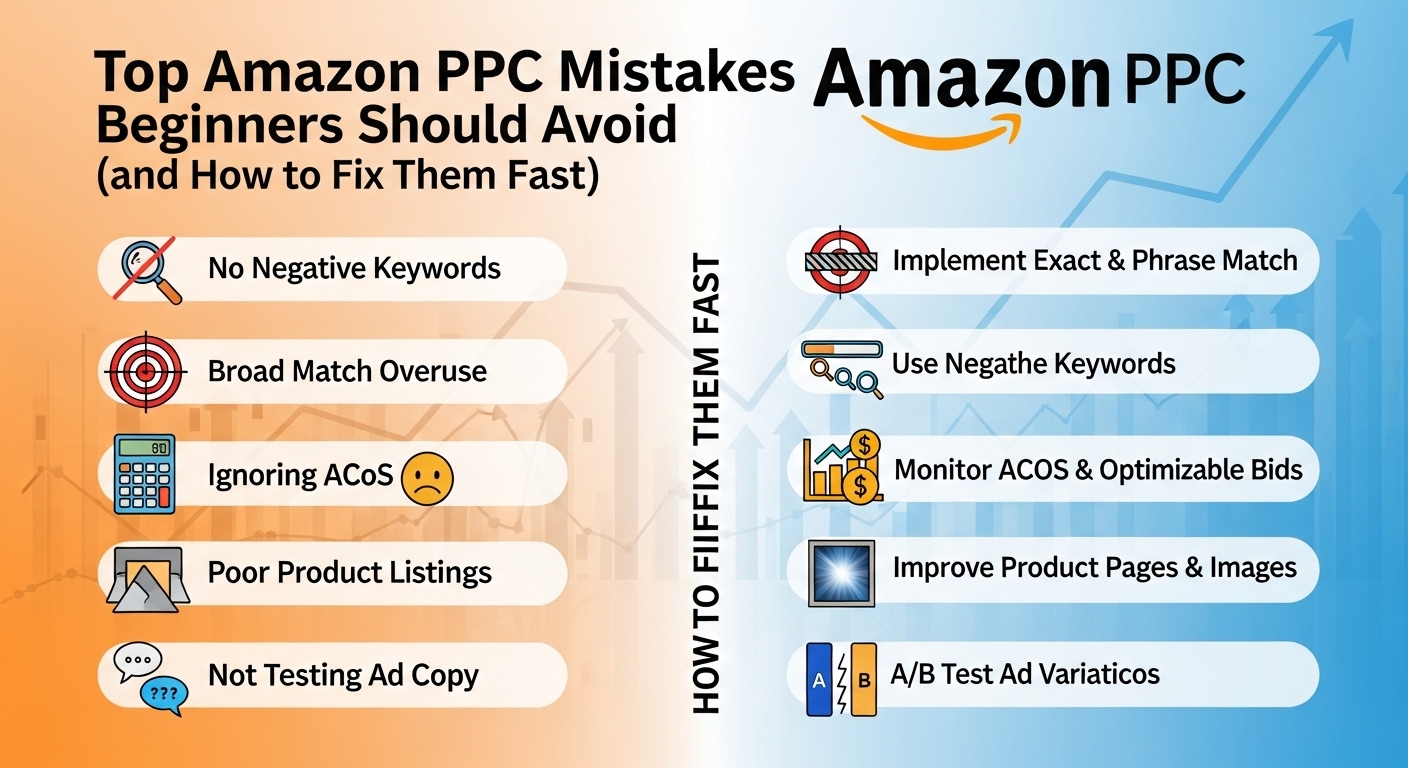
Here’s My Data Table: Common Mistakes vs Fixes
| Amazon PPC Mistake | Impact | Best Ways To Fix |
|---|---|---|
| No clear goal | Wasted ad spend | Define objectives before launching |
| Ignoring match types | Irrelevant clicks | Use Broad → Phrase → Exact |
| Poor structure | Unclear performance | Separate campaigns per product |
| Ignoring ACoS/TACoS | Unprofitable campaigns | Track both metrics regularly |
| No negative keywords | Budget waste | Add negatives weekly |
| Weak listings | Low conversions | Optimize titles, images, bullets |
| Set-and-forget mindset | Declining ROI | Review campaigns every 3 days |
| Auto-only campaigns | Lack of control | Transition to manual targeting |
| Skipping product targeting | Missed opportunities | Use ASIN targeting |
| No analytics use | Lost data advantage | Leverage Brand Analytics |
Conclusion: Master Amazon PPC Before It Masters You
Amazon PPC isn’t complicated — it’s strategic. The difference between sellers who burn budgets and those who build empires lies in understanding the system.
If you avoid these 10 common Amazon PPC mistakes, track your data, and keep optimizing, you’ll turn your ad spend into consistent profit.
Remember, as Kester Terna (EduKester) says:
“Amazon PPC isn’t about spending more — it’s about spending smart.”
So take control, apply these strategies, and start running PPC campaigns that sell while you sleep.
✨ Follow EduKester for more expert tips on Amazon marketing, PPC optimization, and eCommerce success.
Notes
Meta Description:
Learn the top Amazon PPC mistakes beginners make and how to avoid them. Discover smart, data-driven strategies to optimize ads, reduce costs, and boost sales fast.
Tags:
Amazon PPC, Amazon Advertising, PPC Optimization, Amazon SEO, Digital Marketing, eCommerce Ads, Amazon Sellers, Pay Per Click, EduKester, Amazon Strategy
Long-Tail Keywords:
- Amazon PPC mistakes beginners make
- Amazon PPC optimization tips
- How to lower ACoS on Amazon
- Amazon negative keyword strategy
- Amazon PPC campaign structure
Internal Linking Suggestions:
- Link to: “Amazon SEO vs Google SEO: Key Differences”
- Link to: “Building Your Brand with Amazon Digital Marketing & Brand Registry”
- Link to: “7 Powerful Amazon Digital Marketing Strategies for Small Business Success”
